
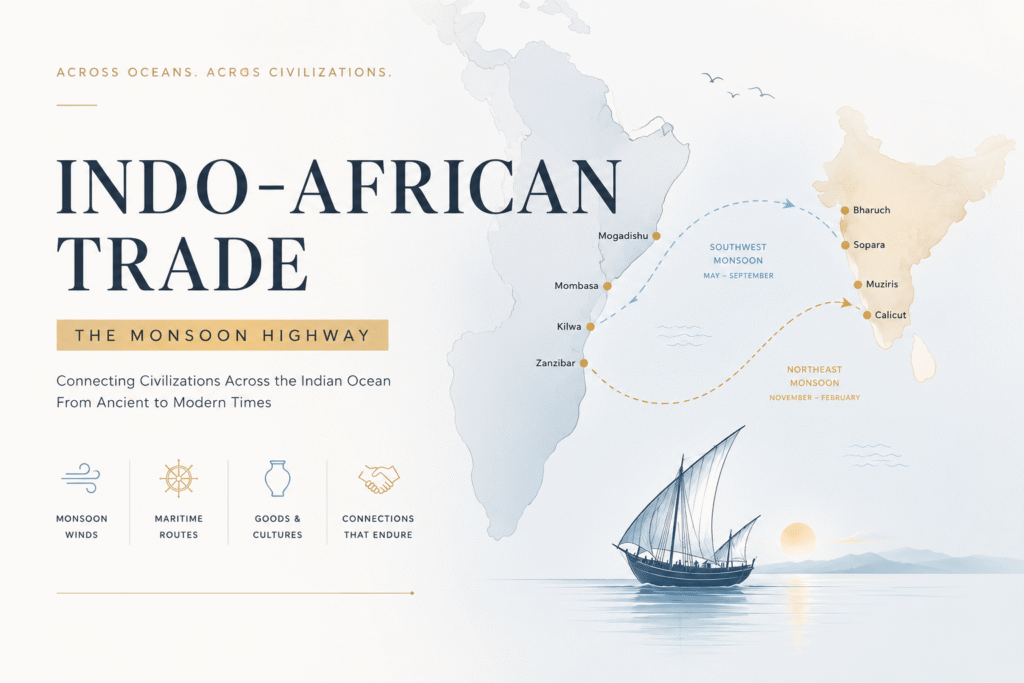
As the southwest monsoon breaks over the Arabian Sea this July, drenching the coasts of Gujarat, Konkan, and Kerala, few commuters cursing the traffic outside their windows realise that the very same winds once dictated the fortunes of empires. The rain that delays a flight out of Mumbai today is the direct descendant of the atmospheric rhythm that, for nearly two thousand years, decided when a merchant ship could leave Barygaza for Africa, how much pepper would reach Rome, and which coastal town would rise to riches or crumble into obscurity. This article traces that rhythm — the monsoon — as the invisible architect of one of history’s oldest and most enduring economic relationships: the trade between India and Africa.
1. Introduction
Long before “globalisation” entered the vocabulary of economists, the Indian Ocean was already a single interconnected marketplace. Unlike the Atlantic or Pacific, where sailing depended largely on unpredictable regional winds, the Indian Ocean possessed a singular, almost mechanical, seasonal wind system — the monsoon — that blew reliably in one direction for roughly six months and reversed for the other six. This predictability turned an ocean that might otherwise have remained a barrier into a highway, and it is this highway that carried Gujarati cotton to the Swahili coast, Zanzibari ivory to Kutch, Yemeni frankincense to Bharuch, and, much later, Indian sugar barons to Kampala. This article examines how monsoon patterns shaped shipping and trade between India and Africa from antiquity through the medieval and colonial periods to the present day, the goods and communities involved, the financial systems that sustained this trade, and the deep cultural imprint each side left on the other.
2. The Science of the Monsoon: Nature’s Shipping Schedule
The Indian Ocean monsoon is generated by the differential heating of the Asian landmass and the ocean. In summer, the heated interior of the subcontinent creates a low-pressure zone that draws moist air in from the southwest — the southwest monsoon, arriving in India roughly between June and September. In winter, the pattern reverses: a high-pressure system over Asia pushes dry winds outward toward Africa and the Arabian Sea — the northeast monsoon, blowing from roughly November to March. For a sailor without an engine, this was not mere weather; it was the sailing schedule itself. A ship travelling from the Red Sea toward India needed to catch the southwest push across the open ocean, while a return voyage — or a journey down the East African coast — depended on the reversed winter winds. Ancient and medieval sailors built their entire commercial calendars, insurance arrangements, and even marriage and festival calendars around this six-month rhythm.
Greek and Roman sources credit a navigator named Hippalus (c. 45–47 BCE) with popularising direct open-ocean sailing using these winds — hence the winds were sometimes called the “Hippalus winds” in classical literature — though Arab and Indian sailors had almost certainly exploited this pattern for centuries before Mediterranean traders formalised it in writing.¹ What Hippalus and his contemporaries “discovered” was less a scientific breakthrough than the documentation of indigenous knowledge that coastal communities of Gujarat, Yemen, and the Somali coast already possessed.
3. Earliest Sources: Piecing Together a 4,000-Year-Old Relationship
Archaeological Evidence
The earliest verifiable contact between the Indian subcontinent and Africa may reach back to the Bronze Age. Some scholars have speculated — controversially — about African-derived populations among the Indus Valley civilisation, while confirmed archaeological evidence includes fourth-century CE coins minted in the Kingdom of Aksum (in present-day Ethiopia) discovered in southern India, testifying to established maritime contact well before the medieval period.² Beads, ceramics, and metal objects of Indian origin have similarly turned up at East African coastal sites, indicating a trade network that long predates written record.
Literary and Primary Textual Sources
The single most important primary source for the ancient Indo-African trade is the Periplus of the Erythraean Sea (Periplus Maris Erythraei), an anonymous Greek merchant’s handbook written around the mid-first century CE, most likely by an Egyptian Greek trader with firsthand experience of these routes.³ Structured as a practical guide rather than a literary work, it lists ports, sailing distances, local rulers, and — crucially — the best months to sail to each destination, revealing just how central monsoon timing was to ancient commercial planning.⁴ The Periplus describes two principal routes fanning out from Red Sea ports such as Berenike and Myos Hormos: one down the East African coast as far as Rhapta (likely near the Rufiji Delta in modern Tanzania), and another across the open ocean to India’s western coast.⁵
Other primary and near-primary sources include:
- Claudius Ptolemy’s Geography (2nd century CE), which mapped the known Indian Ocean world with impressive, if imperfect, precision.
- Al-Masudi, the tenth-century Arab historian, whose travel writings describe East African trading settlements and Indian merchant presence.
- Ibn Battuta’s fourteenth-century travelogue, which vividly recounts his visits to Swahili coast cities such as Kilwa and Mombasa, describing their wealth and cosmopolitan character.⁶
- Sangam-era Tamil literature from South India, which contains references to seafaring, foreign traders, and coastal commerce, corroborating the Periplus’s claims of a bustling Malabar trade.
Cultural and Oral Sources
Beyond texts, the Swahili language itself is a kind of living historical document — a Bantu grammatical structure carrying centuries of Arabic and, to a lesser degree, Indian vocabulary, a linguistic fossil record of the merchants who settled and traded along this coast for over a millennium.
4. The Ancient Period (c. 1000 BCE – 500 CE): Laying the Foundations
Before the Periplus was written, Arab and Indian sailors had already been navigating the western Indian Ocean for generations, using coastal hugging techniques and, eventually, direct monsoon crossings.⁷ By the time Mediterranean traders formalised their knowledge in the first century CE, Indo-Roman trade with India had already been rising for roughly three centuries, riding on infrastructure and knowledge that Indian and Arab mariners had built.⁸
The key nodes of this ancient network carried names that have since faded from common use but were, in their time, as significant as any modern port:
| Ancient Name | Modern Location | Significance |
|---|---|---|
| Barygaza | Bharuch, Gujarat | Chief western Indian port; major manufacturing and re-export centre |
| Muziris | Near Kochi, Kerala | Pepper and spice hub connecting India to the Mediterranean, Persia, and Southeast Asia |
| Rhapta | Near the Rufiji Delta, Tanzania | Southernmost East African emporium mentioned in the Periplus; centre of the ivory trade |
| Azania | East African coast (general) | Greek term for the broader Swahili coastal region |
| Opone | Near modern Somalia (Horn of Africa) | Cinnamon and spice trading post |
From India came cotton textiles, spices (especially pepper), gemstones, and eventually silk arriving via inland routes.⁹ From East Africa came ivory — prized across the ancient world for carving — tortoiseshell (fashioned into combs and decorative objects), and, troublingly, enslaved people, a grim thread that runs continuously through this trade’s history and resurfaces more visibly in later centuries.¹⁰ Roman glassware, wine, and metals moved in the opposite direction, passing through Indian ports on their way further east.
5. The Medieval Period (c. 500 – 1500 CE): The Swahili-Gujarati Golden Age
If the ancient period established the routes, the medieval period built the civilisation around them. Along a 3,000-kilometre stretch of East African coastline running from present-day Somalia to Mozambique, a chain of over thirty-five Swahili city-states emerged — Mogadishu, Barawa, Malindi, Mombasa, Pemba, Zanzibar, Mafia, and, most powerful of all, Kilwa — each a fusion of indigenous Bantu populations with Arab, Persian, and Indian merchant settlers.¹¹ These cities developed Swahili, a Bantu language enriched with Arabic (and to a lesser degree Persian and Indian) vocabulary, which functioned as a lingua franca enabling trade across radically different ethnic communities.¹²
Kilwa’s dominance rested on its control of the gold trade flowing from the interior kingdom of Great Zimbabwe through the port of Sofala — gold that was then shipped north and across the ocean to India and the Middle East. Kilwa held this position partly for a beautifully simple monsoon-driven reason: it was the southernmost port a ship could reach and still return within a single monsoon season, making it the practical terminus for Indian Ocean shipping heading toward the gold-rich south.¹³ Genetic studies published in recent years have even confirmed significant Iranian and South Asian-origin ancestry among medieval Swahili coast populations, offering biological corroboration of centuries of intermarriage between local Africans and merchant settlers from across the ocean.¹⁴
By this period, Gujarati and Kutchi traders were firmly embedded in this network, not merely visiting seasonally but settling in coastal towns, marrying locally, and establishing permanent commercial houses. Goods flowing through this system had diversified considerably: gold, ivory, iron, copper, ebony, sandalwood, and tortoiseshell moved from Africa in exchange for cotton textiles, glass beads, ceramics, and (from further east, via Indian intermediaries) Chinese porcelain and silk.¹⁵ The arrival of the Portuguese under Vasco da Gama in 1498 marked the beginning of the end for this indigenous trading order, as European naval power increasingly sought to seize rather than simply participate in these networks.¹⁶
6. Trade Communities: Who Carried This Commerce?
Indo-African maritime trade was never conducted by nameless, faceless “merchants” — it was carried out by specific, identifiable communities whose descendants, in many cases, still bear these trading identities today.
- Gujarati Banias (Vanias/Banyans): Predominantly Hindu merchants, often of Vaishya caste background, who acted as traders, brokers, and financiers across the western Indian Ocean. Distinguished by strict vegetarian diets and Hindu customs, they typically maintained a transient presence abroad, accumulating wealth before returning to India rather than settling permanently.¹⁷
- Bhatias, Khojas, and Bohras: Both Hindu and Muslim Gujarati trading communities who, by the eighteenth and nineteenth centuries, had become central to Indian Ocean commerce, including — in one of the trade’s darker chapters — financing and participating in the East African ivory-for-textiles trade that became entangled with the transcontinental slave economy supplying French and Brazilian demand in the nineteenth century.¹⁸
- Sindhi and Kutchi merchants: Communities from Sindh and Kutch, whose reach eventually extended global trading networks — nineteenth-century observers likened Sindhi financiers to a “Shikarpuri Rothschild” network for the sophistication of their credit systems.¹⁹
- Swahili and Arab-Omani merchants: The indispensable intermediaries who connected the African interior — where they sourced gold, ivory, and other goods — with overseas markets, and who eventually built the Omani Sultanate of Zanzibar into a formidable trading power.
- Parsi merchants: Particularly active as compradors bridging Indian, African, and British commercial interests during the colonial period.
7. Ocean Connections and Financial Exchange
How did merchants separated by weeks of open ocean, with no telegraph and no banks in the modern sense, actually conduct business, extend credit, and settle debts? The answer lies in one of pre-modern India’s most sophisticated financial inventions: the hundi.
A hundi was a negotiable financial instrument — legally defined in modern India as an unconditional written order directing one party to pay a specified sum to another — that allowed merchants to transfer funds, extend credit, and settle debts across vast distances without physically moving cash.²⁰ Its origins trace back at least to the twelfth century, and by the Mughal era it had become the backbone of long-distance Indian commerce, run not through formal contract law but through networks of trust and reputation among merchant communities, enforced by social and familial obligation rather than courts.²¹ When British colonial authorities encountered the system, they found it so deeply embedded in Indian commercial life that rather than replacing it, they simply began taxing hundi transactions with revenue stamps.²²
This same trust-based credit architecture extended across the ocean. Indian merchant houses operating in East Africa functioned as informal bankers to the interior economy, extending credit to caravan traders heading inland for ivory and gold, and using hundi-like instruments to settle accounts with correspondent firms back in Gujarat or Kutch — effectively creating an early, decentralised international banking system centuries before formal banks arrived. Currency itself was often improvised: cowrie shells served as an accepted medium of exchange in the African interior, while on the coast, Gujarati cotton cloth became so standardised in value that it functioned almost as currency in the ivory trade.²³ Later, coins such as the Maria Theresa thaler circulated widely across the western Indian Ocean rim as a trusted silver standard.
8. The Colonial Disruption and Reorganisation (c. 1500–1947)
Portuguese arrival in 1498 did not end Indo-African trade, but it fractured the indigenous, monsoon-timed trading order that had operated for over a millennium. Portuguese naval power sought to monopolise rather than participate in existing networks, sacking Kilwa and other city-states and imposing tribute systems. Trade did not vanish, however — it adapted, with Indian merchant communities proving remarkably resilient, often continuing operations under new imperial masters (Portuguese, later Omani, later British) by simply adjusting to whichever power controlled the ports.
The most consequential colonial-era development for the modern India-Africa relationship was the construction of the Uganda Railway (1895–1901), often nicknamed the “Lunatic Line.” Facing resistance to local labour conscription, British colonial administrators imported indentured labourers from India — around 32,000 in total, recruited initially through Bombay and later Calcutta after plague disrupted the original port.²⁴ Conditions were harsh: nearly 2,500 workers died and over 6,000 were severely injured during construction, in addition to the famous man-eating lion attacks at Tsavo that killed roughly a hundred workers.²⁵ Roughly 6,700 of these labourers chose to remain in East Africa once their contracts ended, transitioning from railway “coolies” into shopkeepers, artisans, clerks, and traders — the founding generation of what would become East Africa’s influential Indian merchant class, later termed dukawallahs (shopkeepers) from the Swahili word duka, meaning shop.²⁶
9. The Rise of Indian Industrialists in Eastern Africa
What began with railway labourers and petty traders evolved, over a single generation, into some of East Africa’s largest industrial conglomerates. The most famous example is the Madhvani family, whose founder Muljibhai Madhvani arrived in Uganda from Gujarat’s Saurashtra region at just fourteen years old in 1908, initially trading salt, flour, and seashells before building what became, by the 1950s, East Africa’s largest private-sector business — spanning sugar, confectionery, soap, glass, and beverages.²⁷ By the early 1970s, the Madhvani Group alone contributed close to ten percent of Uganda’s GDP.²⁸
Similarly rooted stories built the Mehta Group (tea, sugar, and cable manufacturing in Uganda since the early 1900s) and the Chandaria family’s Comcraft Group, founded in Kenya in 1915, which today operates across more than forty countries producing steel, plastics, and aluminium products.²⁹ These families did not merely trade goods across the ocean — they became the industrial backbone of the economies they settled in, often producing “everything an East African eats, drinks, or washes with,” as one 1960s profile memorably put it.³⁰
This prosperity was violently interrupted in 1972 when Ugandan dictator Idi Amin expelled the country’s entire Asian population — an estimated 60,000–75,000 people — giving them ninety days to leave and nationalising their businesses.³¹ Families like the Madhvanis lost everything overnight, scattering to Britain, Canada, and Kenya, only for many to return and rebuild after Amin’s fall, invited back by President Yoweri Museveni in the 1980s.³² Today, descendants of these communities remain central to East African industry: in 2017, Kenya’s government formally recognised its Indian community as the country’s “44th tribe,” a symbolic acknowledgment of a century-long, often painful, but ultimately foundational contribution to the region’s economy.³³
10. Cultural, Culinary, Religious, and Linguistic Exchange
Trade routes rarely carry only goods, and the Indo-African monsoon corridor left cultural fingerprints on both continents that persist visibly today.
Language: Swahili itself is testament to this exchange — a Bantu language whose vocabulary absorbed substantial Arabic borrowings and, more modestly, Indian and Gujarati terms carried by centuries of resident merchant communities, particularly in areas of commerce and trade terminology.
Cuisine: The Swahili coast’s food culture reflects centuries of Indian Ocean fusion — spices such as cloves, cinnamon, and cardamom (many of them originally routed through or grown alongside Indian trade networks) remain central to Swahili cooking, while dishes like sambusa (clearly derived from the Indian samosa) and biryani-style rice preparations are now considered authentically East African, illustrating how thoroughly Indian culinary influence was absorbed rather than merely imposed.
Religion: Hindu temples and Ismaili and Bohra mosques dot East African cities today, a direct legacy of merchant communities who carried their faiths with them and built durable religious institutions rather than merely trading posts.
The reverse current — African influence on India: This exchange was never one-directional. The Siddi community of India — sometimes called Habshi, from the Arabic word for Abyssinian — traces its ancestry to East and Central African migrants, some of whom arrived as early as the seventh century at the port of Bharuch, with larger waves brought by Arab conquerors, Portuguese traders, and Gujarati merchants trading African captives for Indian textiles between roughly the thirteenth and nineteenth centuries.³⁴ Rather than remaining marginalised, Siddis in India often rose dramatically through social hierarchies — from soldiers and labourers to nobles, officials, and even rulers; the Nawabs of Sachin and Janjira were Siddi dynasties in their own right.³⁵ Genetic studies confirm that today’s roughly 300,000-strong Siddi population, concentrated in Gujarat, Karnataka, and Andhra Pradesh, carries a distinct Bantu-African genetic signature, blended with South Asian and some European ancestry, with admixture estimated to have occurred largely within the past two centuries.³⁶ Siddis today practice a syncretic culture — largely Islamic Sufism blended with African-origin ancestor veneration and music traditions — that stands as living proof that this was always a two-way exchange of people, not merely of goods.
11. The Modern Period: New Currents, Same Ocean
The age of sail ended with steamships and the 1869 opening of the Suez Canal, which fundamentally decoupled shipping schedules from monsoon timing for the first time in millennia — a change so significant that it arguably did more to end the “monsoon economy” than any political revolution. Yet the human and commercial infrastructure the monsoon had built over two thousand years did not disappear; it simply adapted to new technology.
Post-independence, India and African nations found new diplomatic common ground through the Non-Aligned Movement, and this relationship has accelerated dramatically in recent years. India is today Africa’s third- or fourth-largest trading partner (depending on the measure used), with bilateral trade crossing the symbolic USD 100 billion mark in FY 2024–25, compared with roughly USD 56 billion just five years earlier in 2019–20.³⁷ Cumulative Indian investment in Africa now exceeds USD 75 billion, spanning energy, minerals, pharmaceuticals, automobiles, and digital technology, with India extending over USD 12 billion in concessional lines of credit to African nations.³⁸ India remains a critical supplier of affordable generic pharmaceuticals to African healthcare systems, and initiatives such as the India-Africa Business Conclave and growing engagement with the African Continental Free Trade Area (AfCFTA) point toward a relationship its architects hope to double again by 2030.³⁹
12. The Legacy of the Monsoon
It is worth pausing on the strange elegance of this history: a weather pattern, utterly indifferent to human affairs, quietly dictated where cities would rise (Kilwa’s fortune depended on being reachable within a single sailing season), which merchant communities would grow wealthy, and even how far south the gold trade of Great Zimbabwe could reasonably travel before profits evaporated into shipping delays. The steamship and the Suez Canal eventually broke that dependency, but they did not break the human networks the monsoon had built. The Gujarati trading houses, the Swahili port cities, the hundi-based credit systems, the Siddi communities of Gujarat, and the industrial dynasties of Kampala and Nairobi are all, in a real sense, monsoon artefacts — durable social and economic structures that outlived the wind pattern that first made them possible.
13. Conclusion
The next time monsoon clouds gather over the Arabian Sea and rain sweeps across India’s western coast, it is worth remembering that this same seasonal rhythm once carried far more than water. It carried Gujarati cotton to Zanzibar and East African ivory to Bharuch; it carried Siddi communities into India and Indian merchant dynasties into the heart of East African industry; it carried credit instruments built entirely on trust across an ocean with no telegraph, and it carried two civilisations into a relationship of exchange, dependency, exploitation, and ultimately deep cultural fusion that neither side has ever fully unwound. From the anonymous Greek merchant who wrote the Periplus to the Commerce Minister announcing a USD 100 billion trade milestone in 2025, the fundamental story has changed remarkably little: India and Africa, connected by an ocean that the monsoon first taught humans how to cross.
References and Select Bibliography
- Scroll.in, “What a 2,000-year-old Greek merchant’s manual tells us about the Indian monsoon and oceanic trade,” November 2019.
- BlackPast.org, “Who are the Siddis? A Brief Introduction to the 800-Year African Experience in India,” March 2025.
- Wikipedia, “Periplus of the Erythraean Sea,” accessed 2026; World History Encyclopedia, “Periplus of the Erythraean Sea.”
- Scroll.in, op. cit.
- Grokipedia, “Periplus of the Erythraean Sea,” January 2026; World History Encyclopedia, op. cit.
- Boston University African Studies Center, “The Swahili Coast and Indian Ocean Trade” (teaching resource listing primary sources including Ibn Battuta, Al-Masudi, and Ptolemy).
- Scroll.in, op. cit.
- Ibid.
- Studocu, “The Periplus of the Erythraean Sea: A 1st Century Trade Analysis,” October 2024.
- Ibid.
- World History Encyclopedia, “Kilwa”; Humanities LibreTexts, “2.5: Swahili City States.”
- Humanities LibreTexts, op. cit.
- Ibid.
- Wikipedia, “Kilwa Sultanate,” citing 2023 genetic study on Swahili coast ancestry.
- Charter Cities Institute, “Building Africa: Kilwa Kisiwani, the Indian Ocean Trade, and the Rise of East African City-States,” May 2022.
- Wikipedia, “Swahili coast.”
- Grokipedia, “Banyan merchants,” January 2026.
- Eurasia Review, “Indian Merchants From Gujarat Played Key Role In African Slave Trade – Analysis,” June 2021, citing Pedro Machado, Ocean of Trade: South Asian Merchants, Africa and the Indian Ocean (Cambridge University Press).
- Madras Courier, “The Hundi System, Indian Merchants & Global Trade,” March 2023.
- Wikipedia, “Hundi”; Grokipedia, “Hundi,” January 2026.
- Filtered Kapi (Substack), “Mughal-Era Finance: How Native Bankers and the Hundi System Shaped India’s History,” June 2025.
- Wikipedia, “Hundi,” op. cit.
- Eurasia Review, op. cit.
- Striking Women (online resource), “Indentured labour from South Asia (1834–1917).”
- National Railway Museum Blog, “Beyond the ‘Lunatic Line’: Ugandan Asians and British Railways.”
- Daily Nation (Kenya), “The Indian heroes who built railway,” July 2020; KenyanHistory.com, “The Indian Labourers Who Built the Uganda Railway,” November 2025.
- Quasar Energy, “Madhvani History”; Friends of Mombasa, “Historic Mombasa – The Hindu Community.”
- Forbes India, “Experiences Of The Indian Diaspora In Africa,” August 2009.
- The Independent (Uganda), “Who are Uganda’s influential Indian business families?,” December 2024; Businessday NG, “18 Indian billionaires who built their wealth in Africa,” November 2024.
- TIME Magazine Archive, “Africa: The Confident Kinsmen.”
- Forbes Africa, “The Madhvanis: The Industrialists Who Have Tasted Sucrose And Success,” April 2019.
- Forbes India, op. cit.
- KenyanHistory.com, op. cit.
- Wikipedia, “Siddi”; Sarmaya Arts Foundation, “A Proud Past: The Siddis of Gujarat,” January 2024.
- Sarmaya Arts Foundation, op. cit.
- PMC (National Library of Medicine), “Indian Siddis: African Descendants with Indian Admixture” and “Unraveling the Population History of Indian Siddis.”
- Business Standard, “India-Africa trade surpassed $100 bn in 2024-25,” August 2025; Currentaffairs.adda247.com, same milestone, August 2025.
- Ibid.
- Ensure IAS, “Recalibrating India-Africa Economic Ties,” December 2025; Sunday Independent (South Africa), “India-Africa trade exceeds $80bn in 2024/25,” December 2025.
Note: This article draws on secondary journalistic and reference sources, genetic and archaeological studies, and citations of primary historical texts (the Periplus of the Erythraean Sea, Ptolemy’s Geography, and Ibn Battuta’s travelogues) as referenced by the above secondary sources. Readers seeking deeper academic engagement are encouraged to consult primary translations of the Periplus (Casson, 1989) and Pedro Machado’s Ocean of Trade: South Asian Merchants, Africa and the Indian Ocean, c. 1750–1850 (Cambridge University Press, 2014) for rigorous scholarly treatment of these themes.
